

Skip to content
SVENNISAI
Blog · Claude certification

Claude Certified Architect: what it covers and what it means when you hire a partner

The Claude Certified Architect exam is open only to staff of Claude partner firms. Here is what it covers, how to check a badge, and what it does not prove about a partner.
9 min readThe Svennis team. Drafted with Claude, reviewed by the team. Editorial policy
A spotless hard hat with a gold badge beside a scuffed, mud-splattered hard hat on a plain surface

Claude Certified Architect: what the certification is and what it proves

The Claude Certified Architect is an Anthropic certification exam on building production systems with Claude, and only people at Claude partner firms can sit it. For you as a buyer, the badge proves one thing. The holder passed an exam built around production Claude development. It does not prove they have delivered a project like yours.

That gap is the whole point of this guide. A certification tells you someone knows the material. A delivered system tells you they can apply it to messy data, real staff and your existing software. You need both, and you need to know which one you are looking at.

The details on the exam come from Anthropic's public exam guide, as summarised in a Claude Architect study guide published on Medium. The details on the network and the newer residency badges come from Anthropic's own pages. If you are still getting to grips with the product, read a plain explanation of what Claude is first.

What the Claude Certified Architect exam guide covers

The Claude Certified Architect exam guide is public and covers five domains that map to production Claude development. Anyone can read it, even though only partner staff can take the exam. That makes it useful to you: you can check what a certified person was tested on.

The study guide's author lists the hands-on work they recognised in the exam guide. It reads like a list of the jobs a partner does for a client:

  • building MCP servers, which let Claude call tools in other software, connected to programs such as Airtable and Notion;
  • configuring Claude Code, Anthropic's tool to plan, write, debug and ship software, across team projects;
  • writing custom skills and layered CLAUDE.md instruction files;
  • writing tool descriptions clear enough that Claude picks the right tool;
  • debugging orchestration failures and context isolation limits in pipelines with several agents.

Skills deserve a word of explanation. Agent Skills is the open standard that gives AI agents specialised knowledge and workflows. According to Anthropic's newsroom, more than 70 agent platforms have integrated it since December 2025. A partner fluent in skills is building on a widely used format, not a private one.

The author's own failures are instructive. They describe tools that misrouted because the descriptions were lazy. That is exactly the kind of mistake the exam tests for, and exactly the kind you want your partner to have made already, on someone else's project.

Who can sit the exam: staff of Claude partner firms only

Only Claude partners can take the Claude Certified Architect exam. So a badge holder works, or worked, for a firm in the Claude Partner Network, Anthropic's programme for consultancies and integrators that implement Claude.

Claude certifications are common inside that network. Anthropic reports that professionals across 46,000 firms have earned more than 175,000 Claude certifications. Nearly 4,000 people have also completed Basecamp. Basecamp is an immersive partner programme that teaches the same material Anthropic's Applied AI teams receive when they join.

Read those figures as a floor, not a ceiling. A partner without any certified staff would be unusual. A partner with certified staff is normal. The certification earns a firm a place on your shortlist. It does not, by itself, move a firm to the top of it.

Two practical questions follow from this. First, is the certified person actually on your project, or only on the firm's website? Second, which Claude credential do they hold? The network now has several, and they test different things.

How the certification compares with other Claude credentials

The Claude Certified Architect is one of several Claude credentials, and each tests something different. The table sets them side by side, using only what Anthropic and the exam guide state. Use it to judge what a credential on a proposal actually tells you.

CredentialWho earns itHow it is assessedWhat it tells you
Claude Academy course, for example AI FluencyLearners on Claude Academy14 lessons and 1 quiz, about 4 hoursThe person knows how to work with Claude day to day
Claude Certified ArchitectStaff of Claude partnersExam against a public guide with five domainsThe person knows production Claude development
Claude Resident Engineer badgeEngineers nominated to Claude Frontier AcademyGraded practical on a new scenario after an in-person programmeThe person handled a simulated enterprise deployment
Claude Frontier Deployed Engineer badgeEngineers who finish the 12-week residencyAssessment after leading a real Claude use caseThe person led a live deployment and passed review
Claude Partner Network directory listingFirms, not individualsListing as a certified consulting partner or system integratorThe firm is in Anthropic's partner programme

The Academy courses sit at Claude Academy. They teach using Claude well, including the 4D framework of Delegation, Description, Discernment and Diligence. They are good for your own staff. They are not a substitute for an architect's exam.

Claude Frontier Academy badges: assessed on real deployments

Claude Frontier Academy is Anthropic's programme to train Frontier Deployed Engineers, the people who lead Claude deployments inside organisations. Anthropic has backed it with a $100 million commitment. The aim is 10,000 Frontier Deployed Engineers by the end of 2027.

The Academy's first programme, the Frontier Deployed Engineer Residency, follows a medical model. Engineers learn from practitioners, practise on realistic cases and are assessed before they earn a credential. The steps run in this order:

  1. A multi-day in-person programme with Anthropic engineers and licensed instructors, built around a simulated enterprise deployment.
  2. A graded practical on a new scenario. Those who pass earn the Claude Resident Engineer badge.
  3. A 12-week residency in which the engineer leads a real Claude use case at their own organisation.
  4. A final assessment. Those who pass earn the Claude Frontier Deployed Engineer badge.

Timing matters when you read a proposal. Anthropic expects the first Frontier Deployed Engineer badges in early 2027. Participation is by nomination, and each engineer arrives with a named Claude project to lead. First cohorts include engineers from Commonwealth Bank of Australia, Morgan Stanley and Novo Nordisk.

Prior experience building AI agents is not required for the residency. Details are on Anthropic's Claude Frontier Academy announcement.

The Claude Partner Network directory checks the firm, not the person

The Claude Partner Network directory lists firms, so it confirms a company's status, not an individual's certification. Anthropic describes it as the place to find a Claude certified consulting partner or system integrator to build your AI strategy and implement Claude.

Use the two checks together. Search the Claude Partner Network directory for the firm's name. Then check the badge of the named person who will lead your work. A listed firm with no certified person on your project gives you the logo without the expertise.

The directory is dominated by large global consultancies and integrators. Some of them describe embedding Claude-certified engineers directly in customers' environments. That is a useful benchmark for any firm, large or small: ask where the certified people will sit and how much of their time your project gets.

For a plain account of what partner status involves, read what partner status in the Claude Partner Network means. Keep the distinction clear when you compare proposals. Partner status describes a firm's relationship with Anthropic. A certification describes what one person passed.

How to check a Claude certification badge before you sign

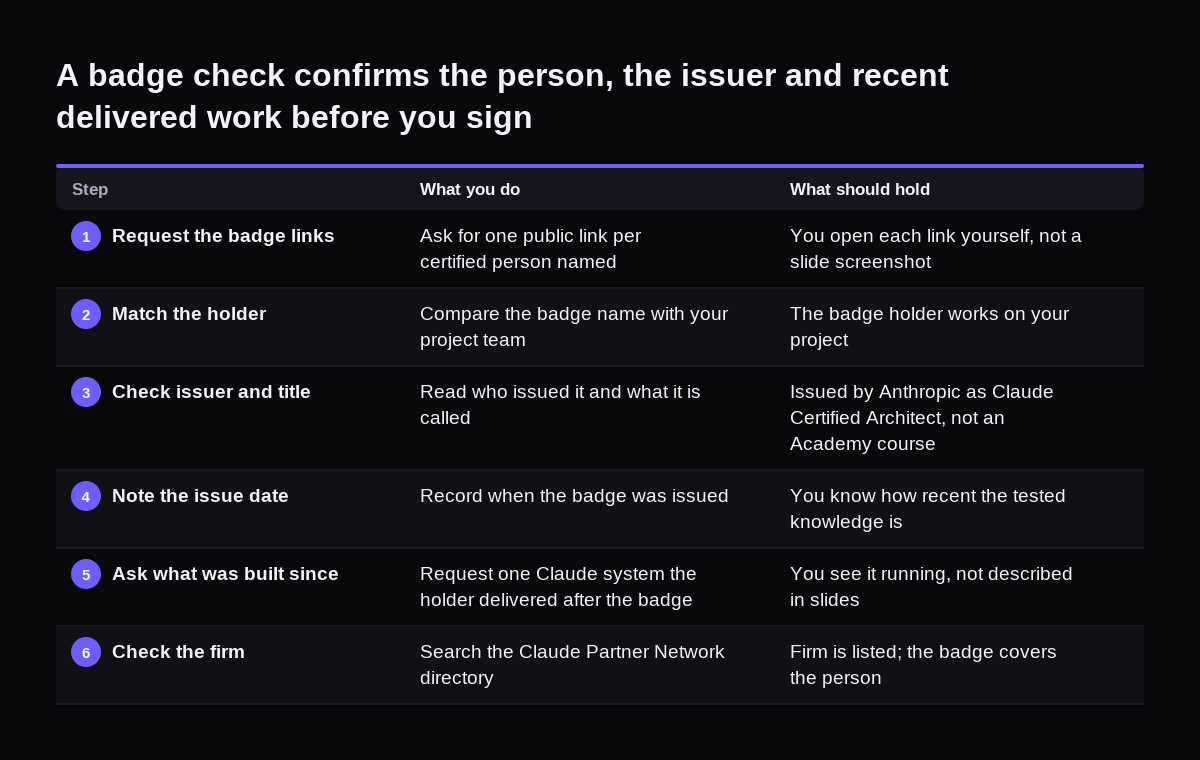
Checking a Claude certification badge takes about ten minutes and should happen before you sign any statement of work. Digital badges are issued with a public link. Ask for it, open it yourself, and do not rely on a screenshot in a slide deck.

Work through these checks in order:

  1. Ask the partner for the public badge link of each certified person named in the proposal.
  2. Confirm the name on the badge matches the person on your project team.
  3. Confirm the issuer is Anthropic and the credential name matches the one claimed, for example Claude Certified Architect rather than an Academy course.
  4. Note the date the badge was issued.
  5. Ask what that person has built on Claude since the badge was issued, and for one system you can see working.

The last step carries the most weight. The exam guide maps to production work, but the badge records a pass, not a portfolio. A certified architect should be able to talk through a real build without slides: which tools Claude calls, how each is described, and what broke first.

Treat a refusal to share the link as a warning. Treat a vague answer to the last question as a bigger one.

A badge check confirms the person, the issuer and recent delivered work before you sign. What you do / What should hold. 1. Request the badge links: Ask for one public link per certified person named / You open each link yourself, not a slide screens

Worked example: testing a certified architect against a Zoho CRM project

A certified architect is best tested with your own project, not general questions. Take a 40-person firm running Zoho CRM and Zoho Desk. It wants Claude to read incoming support emails, send each to the right team in Zoho Desk and log the contact in Zoho CRM. The proposal names a Claude Certified Architect as lead.

Four questions to put to the architect

  • Which model runs the routing step? Anthropic positions Claude Haiku 5.5 for high-volume, latency-sensitive classification, extraction and routing. It suggests Claude Opus 5.5 when unsure. A good answer explains the trade-off; see when Claude Opus 5.5 is worth using.
  • How will each tool be described? Vague tool descriptions make Claude misroute. Ask to see a draft description.
  • What fails if an administrator changes a setting? Anthropic notes that organisation settings, such as disabling web search, can make requests fail even when the model supports the feature.
  • How will Claude reach Zoho? Expect options: a connector, an MCP server, a plugin or a skill, each with its cost, so you choose.

At Svennis we write the description for every tool before we build the connection, then run the routing against live tickets with the client's team watching. When routing goes wrong at a client, we usually trace it to a loose description rather than the model, and rewriting it fixes the problem faster than changing models.

What the certification means for a UK or European company

For a UK or European company, the Claude Certified Architect badge answers a technical question, not a legal one. The exam guide covers building with Claude. It does not tell you where your data sits, which contract applies or what your staff may put into Claude.

Ask those questions separately, and expect a certified architect to know where to find the answers. How Claude runs in your company, from account to data to UK law sets out what to check. A partner who cannot discuss it alongside the build is giving you half a service.

The talent base is growing close to home. Claude Frontier Academy cohorts are running in London as well as San Francisco and New York. Large British organisations are also moving: Barclays is expanding its collaboration with Anthropic to integrate enterprise AI systems across its global operations. Expect more UK candidates with residency badges from 2027.

Language is the other European angle. All current Claude models support multilingual work, alongside text, images, vision and tool use. If your teams work in German, Romanian or Italian, ask the architect how they will test routing and replies in each language. Passing an exam in English does not answer that for you.

Next steps: using the certification in your partner shortlist

The Claude Certified Architect badge belongs on your shortlist checklist, next to evidence of delivered work. Use it to filter, then judge partners on how they handle your own process.

Before your next partner conversation, do the following:

  1. Write down the one process you want Claude to handle first, and the programs it touches.
  2. Ask each partner to name the certified person who will lead it, and get the public badge link.
  3. Check the firm in the Claude Partner Network directory.
  4. Put the four worked-example questions to the named architect, using your process.
  5. Ask to see one system that person built, running, not in slides.

If you want to see how this looks with Svennis, the work runs in four steps. It starts with a Workshop. Then comes a pilot: Pilot Claude A puts an AI agent on Claude to work on one process, or Pilot Claude B rolls out Claude Team to the whole team. A department Activation follows, then monthly operations.

For costs, plans and a sensible first step, read what Claude for business costs and how to start.

Sources

  1. The complete Claude Architect study guide (Data Science Collective, Medium)
  2. Claude Frontier Academy: $100M to train 10,000 engineers (Anthropic)
  3. Claude Partner Network Directory
  4. Claude Academy
  5. Newsroom (Anthropic)
  6. Models overview (Claude Platform Docs)
Free, 30 minutes

Pick a time. Bring the process this article made you think of.

You leave with a clear yes or no on putting Claude on it, and the step that fits from our published prices. You speak to someone who builds the agents, not a salesperson.

Prefer to call? +44 7588 772736

30 minutes · video call · free
  1. 1Time
  2. 2Details
  3. 3Booked