

Skip to content
SVENNISAI
Blog · Claude Code

Claude Code pricing for a UK development team: seats, usage and API billing

Claude Code has no price of its own. It comes with Pro, Max and Team seats or runs on API tokens. This guide compares them for a team of five to twenty developers.
9 min readThe Svennis team. Drafted with Claude, reviewed by the team. Editorial policy
A taxi fare meter beside three fanned travel season cards, contrasting fixed monthly seats with pay-as-you-go metered billing

Claude Code pricing in short: a paid Claude plan or API tokens

Claude Code is not sold on its own. You pay for it in one of two ways. Your developers can get it with a paid Claude plan: Pro from $17 a month billed annually, Max from $100, or a Team seat from $20. Alternatively, you pay per token through the API.

Claude Code is Anthropic's agentic coding tool. It reads your repository, edits files and runs commands from the terminal, an IDE extension, the desktop app or the web. The Claude pricing page states that Claude Code is included in all paid plans. It also shares the same usage limits as the rest of the plan.

For a team of five to twenty developers, the real choice sits between three options:

  • Team standard seats.
  • Team premium seats.
  • Metered API billing.

Since 7 October 2026, Max and Team plans also include monthly API credits, which changes the sums for teams that build their own agents. This guide gives the list prices, a worked example for ten developers and a decision table. Anthropic publishes its list prices in US dollars. Our Claude pricing page for the UK shows the same plans in pounds.
What Claude Code is, and how a developer gets access to it

Claude Code is a coding agent that works inside your codebase. It does not just answer questions in a chat window. According to the Claude Code documentation, it runs on several surfaces: the terminal, IDE extensions, a desktop app and the web. All of them connect to the same engine. A repository's CLAUDE.md file, its settings and its MCP servers therefore work the same on each.

Two terms recur in any Claude Code budget:

  • CLAUDE.md is a markdown file in the project root that Claude Code reads at the start of every session. Teams use it for coding standards, architecture decisions and review checklists.
  • MCP (Model Context Protocol) is an open standard for connecting AI tools to outside data. With it, Claude Code can update tickets in Jira or read design documents in Google Drive.

Access depends on the account behind it. The documentation says most surfaces require a Claude subscription or an Anthropic Console account. The Console account is the route for API billing. The desktop app includes Claude Code and requires a paid subscription. Teleport, which moves a session between surfaces, requires a claude.ai subscription.

The billing choice therefore affects more than the invoice. It also decides which surfaces your developers can use.

Which Claude plans include Claude Code, at list price

Every paid Claude plan includes Claude Code. The Free plan does not. The table below lists Anthropic's published US dollar prices per person per month, from the Claude pricing page. Where a plan offers annual billing, both prices are shown.

PlanBilled annuallyBilled monthlyUsage, as Anthropic describes it
Pro (one person)$17$20Baseline individual plan
Max (one person)Not listedFrom $1005x or 20x more usage than Pro
Team standard seat$20$25More usage than Pro
Team premium seat$100$1255x more usage than a standard seat
Enterprise seatUS$20 plus usage at API ratesNot offered20 seat minimum

The Team plan is for teams of 2 to 150, so it fits a development team of five to twenty. Anthropic's release notes confirm that Claude Code access has been included with every Team standard seat since January 2026. A Team plan can mix the two seat types. You can give heavy users premium seats and everyone else standard seats.

Pro and Max are individual plans. They suit a single contractor or a founder who codes. They do not suit a team that needs central billing and admin control. Enterprise adds API-rate usage on top of the seat fee, and its 20 seat minimum makes it a fit only for the top of the five to twenty range.

How usage limits decide whether a standard seat is enough

Usage limits decide whether a standard seat is enough, so they belong in any Claude Code budget. Every plan's limits reset on a rolling five-hour session window, and paid plans add weekly limits on top. Claude Code shares one usage pool with Claude on the web, desktop and mobile. A developer's chats and terminal work therefore draw on the same allowance.

AgentStackList's Claude Code pricing summary also notes that Anthropic publishes no fixed message count. Usage depends on conversation length, the model and the features used.

When a developer hits a limit on a paid plan, there are three options. They can wait for the reset, move to a bigger seat or turn on usage credits. Usage credits let the developer keep working at standard API rates, billed on top of the seat. Two details matter for cost control:

  • The /usage command in Claude Code shows the plan usage bars and a breakdown by skills, subagents, plugins and MCP servers.
  • On a subscription, the dollar figure in the /usage Session block is not your bill.

In practice, usage credits act as a safety valve, not a budget line. If one developer draws on credits every week, a premium seat is usually the simpler and more predictable answer.

Paying for Claude Code through the API instead of seats

API billing means paying per token through an Anthropic Console account, with no seat fee. A token is a piece of text the model processes. You pay separately for input tokens (what Claude reads) and output tokens (what it writes). The Claude Platform pricing documentation lists these base prices per million tokens:

ModelInput, per million tokensOutput, per million tokensAnthropic's positioning
Claude Fable 5.1$10$50Demanding reasoning and long-horizon agentic work
Claude Opus 5.5$4$20Long-running agentic coding and knowledge work
Claude Sonnet 5.5$2$10Best combination of speed and intelligence
Claude Haiku 5.5$0.10$0.50Prompts up to 100,000 tokens; high-volume tasks

The models overview advises starting with Claude Opus 5.5 for most workloads if you are unsure. Three pricing rules lower the bill:

  • A prompt cache hit costs 10% of the standard input price. Caching reuses parts of a prompt that Claude has already processed.
  • The Batch API halves input and output prices for work that can wait.
  • Volume discounts are negotiated case by case for high-volume users.

One rule can raise it. Newer models use a tokenizer that produces about 30% more tokens for the same text. A cost estimate based on an older model will therefore come out low. API billing has no usage limits to manage, but it also has no ceiling.

Monthly API credits on Max and Team plans since 7 October 2026

Since 7 October 2026, Max and Team plans include monthly API credits. The release notes say these credits are for running your own apps and agents on the Claude Platform. That is the API, not the chat and Claude Code allowance of the seats themselves.

For the Team plan, the Claude pricing page lists up to $500 per month in pooled API credits. "Pooled" means the organisation shares one balance rather than each seat holding its own. The page marks this figure with a footnote. Read the terms on the pricing page before you count on the full amount. The pack of sources behind this guide does not give a figure for the credits on Max.

For a development team, the credits change what the Team plan covers. Developers keep using Claude Code inside their seat allowance. The pooled credits can then fund API work that would otherwise need a separate budget, for example:

  • An internal agent that reviews pull requests.
  • A script that drafts release notes.
  • A prototype of a customer-facing feature built on Claude.

The credits do not replace a seat. They are an allowance for building on the API, priced at the token rates in the previous section. A Team plan that uses its credits well can delay or remove the need for a separate Console account during early development.

Worked example: a ten-developer team priced four ways

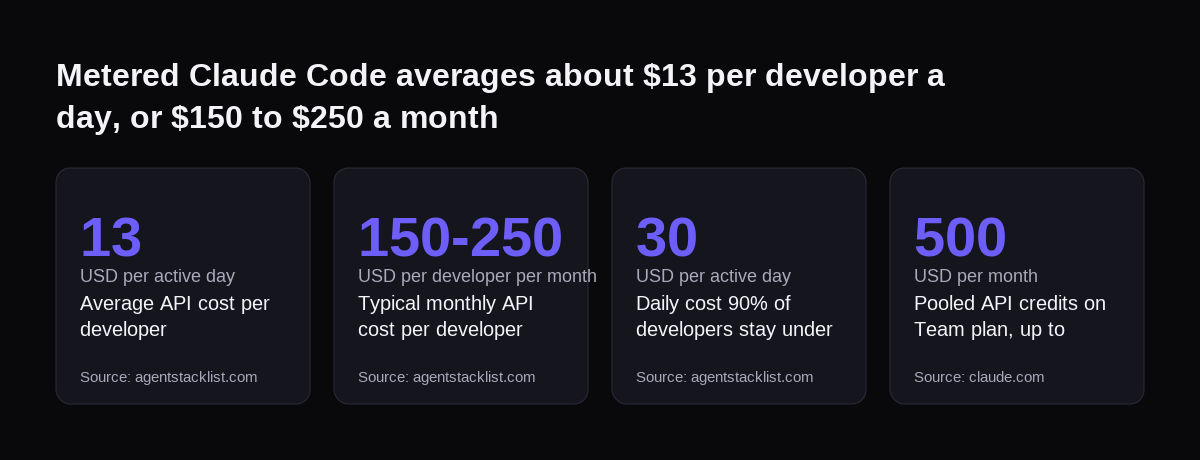
A team of ten developers on annual billing can pay as little as $200 a month for Claude Code or several times that. The difference comes from the seat mix. The figures below use the list prices from the Claude pricing page. For metered use, they use AgentStackList's reported range of $150 to $250 per developer per month for enterprise API use.

OptionMonthly costYearly costWhat it buys
10 standard seats$200$2,400Claude Code for all, standard limits, pooled API credits
3 premium and 7 standard seats$440$5,2805x usage for the three heaviest users
10 premium seats$1,000$12,0005x usage for everyone
API only, no seats$1,500 to $2,500$18,000 to $30,000No limits, no ceiling, Console account access

The mixed plan is the usual starting point. On monthly billing, the same mix costs $550 a month: 3 × $125 plus 7 × $25.

The API row is a reported range, not a quote. Your own codebase and habits will move it. Even so, the comparison shows the pattern. Seats cap your monthly spend, and per-token billing for full-time developers tends to cost more.

At Svennis, we start a development team on standard seats, read the /usage breakdown after the first weeks and then move only the developers who keep hitting limits to premium seats. That order keeps premium spend tied to actual use rather than to guesses made on day one.

Metered Claude Code averages about $13 per developer a day, or $150 to $250 a month: Average API cost per developer 13 USD per active day, Typical monthly API cost per developer 150-250 USD per developer per month, Daily cost 90% of developers stay u
Source: agentstacklist.com, claude.com

How to choose a Claude Code setup for five to twenty developers

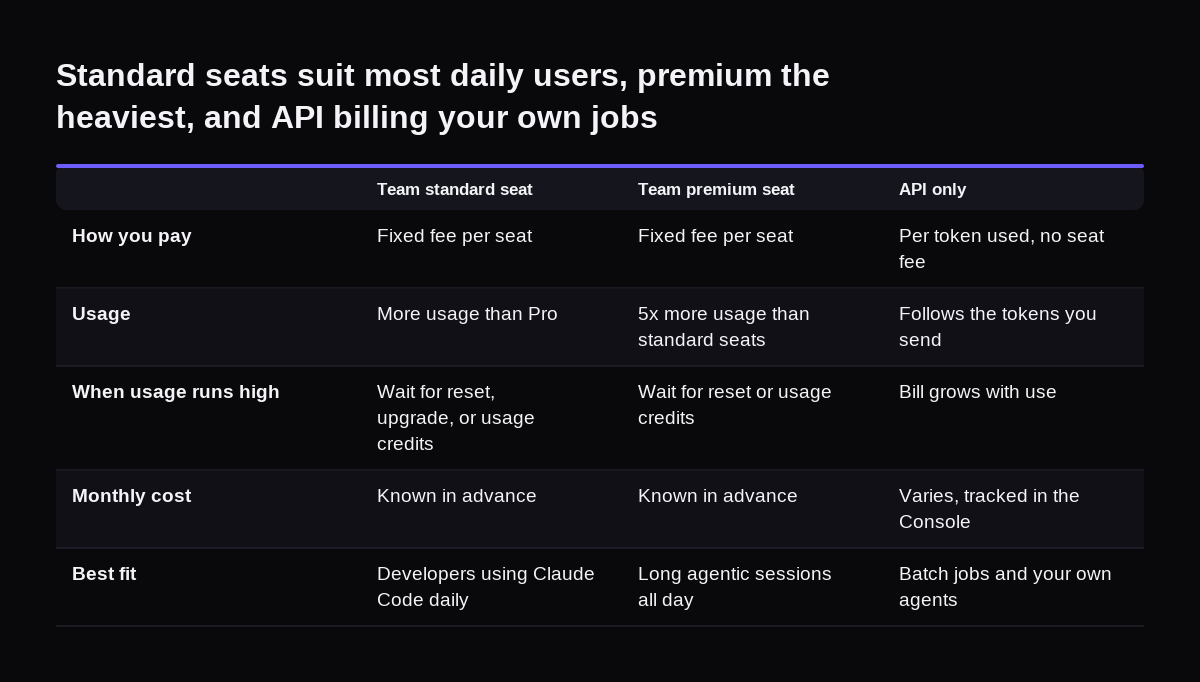
For most teams of five to twenty developers, Team seats with a mix of standard and premium are the right default. Choose API billing only for a specific workload that suits it. The table below matches common situations to a setup.

Your situationSetupWhy
Most developers use Claude Code daily, a few very heavilyTeam, standard seats plus premium for heavy usersFixed monthly cost; premium only where limits bite
Everyone runs long agentic sessions all dayTeam, premium seats5x usage per seat at a known price
Usage is occasional or uneven across the teamTeam, standard seats with usage credits switched onOverflow billed at API rates only when needed
You are building your own agents on the APITeam seats plus the pooled API creditsCredits fund API work without a second budget
Automated jobs in CI or overnight batchesAPI through a Console accountBatch API halves token prices for work that can wait
Twenty or more seats and audit or SCIM needsEnterprise20 seat minimum; seat fee plus usage at API rates

Two checks prevent most mistakes. First, decide who owns the seat list, so that leavers lose access on their last day. Second, review the /usage breakdown monthly before you change any seat type. If your team also wants Claude for work beyond code, Team premium seats include Claude Cowork as well as Claude Code.

Standard seats suit most daily users, premium the heaviest, and API billing your own jobs. Team standard seat / Team premium seat / API only. How you pay: Fixed fee per seat / Fixed fee per seat / Per token used, no seat fee; Usage: More usage than P

What Claude Code pricing means for a UK company

A UK company buys Claude Code from a price list published in US dollars. Plan your budget and your compliance checks with that in mind. The GBP prices for Pro, Max, Team and the API are on our UK pricing page. Use those for internal approval rather than converting the dollar list yourself. Compare seats and API spend on the same basis, excluding VAT, so the two options line up.

Three points from Anthropic's own pages matter for UK buyers:

  • Refunds: Anthropic's 14-day withdrawal refund for UK and EEA customers comes from consumer law and covers individual plans bought as a consumer. A company buying Team seats should not plan on a cooling-off refund.
  • Training on your code: Team and Enterprise plans do not train models on your content by default. Individual plans such as Pro and Max are covered by Anthropic's consumer terms instead, so check each person's privacy settings before any company code goes near one. That is a reason to keep a team's source code on Team seats.
  • Region: US-only inference costs 1.1x on input and output tokens. A UK team pays that only if it pins a workload to US-only inference.

Data protection still applies when developers paste logs or customer records into a session. The ICO's guidance on AI and data protection explains how UK GDPR principles apply to information used in AI systems. Our annotated UK GDPR articles for AI cover the parts most relevant to a development team.

Next steps to price Claude Code for your team

To price Claude Code for your own team, work through these steps in order:

  1. Count the developers who would use Claude Code every day, and those who would use it occasionally.
  2. Price a Team plan with all standard seats, then a mixed plan with premium seats for your heaviest users.
  3. Switch on usage credits as an overflow, with a monthly cap you are comfortable with.
  4. Decide what the pooled API credits will fund, for example a review agent or a prototype.
  5. Keep automated and batch jobs on a separate Console account, so their cost is visible on its own.
  6. After the first month, read the /usage breakdown and adjust seat types.

If you want help with the setup itself, Svennis works in four steps. These are the Workshop, a Pilot, the department Activation and then monthly operations. For a development team, the relevant pilot is Pilot Claude B, which sets up Claude Team for the whole team. The alternative, Pilot Claude A, puts an AI agent on Claude for one process. Fees for each step are on the Svennis prices page.

Sources

  1. Claude by Anthropic: Plans and pricing
  2. Claude Platform Docs: Pricing
  3. Claude Code Docs: Overview
  4. Claude Help Center: Release notes
  5. Claude Platform Docs: Models overview
  6. AgentStackList: Claude Code pricing, plans and usage limits
  7. ICO: Artificial intelligence
Free, 30 minutes

Pick a time. Bring the process this article made you think of.

You leave with a clear yes or no on putting Claude on it, and the step that fits from our published prices. You speak to someone who builds the agents, not a salesperson.

Prefer to call? +44 7588 772736

30 minutes · video call · free
  1. 1Time
  2. 2Details
  3. 3Booked