
Skip to content
SVENNISAI
Blog · Data Use and Access Act

Data Use and Access Act 2025 for companies using AI: what changed and what to do

The Data Use and Access Act 2025 changes automated decisions, legitimate interests, complaints handling and cookies. This guide shows what a UK company using AI should update.
10 min readThe Svennis team. Drafted with Claude, reviewed by the team. Editorial policy
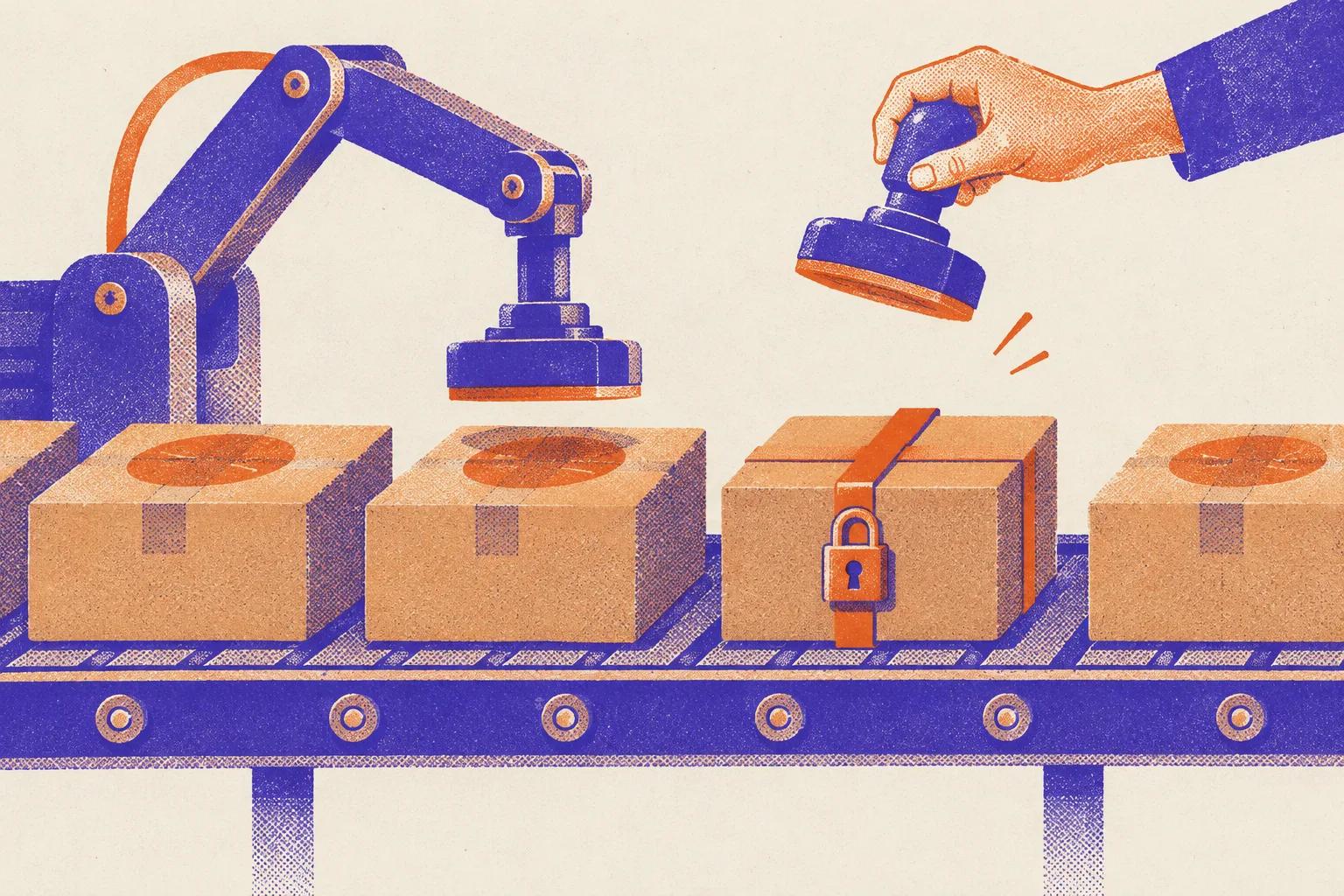
A robotic stamp arm over a conveyor belt as a hand lifts it clear of one padlocked parcel among plain ones

Data Use and Access Act 2025 for AI users: what changed

The Data Use and Access Act 2025 changes four things a company using AI must act on. These are the rules on automated decisions, a list of recognised legitimate interests, a new duty to run a data protection complaints process, and cookie consent under PECR. The ICO says all the data protection and PECR provisions are now in force.

The Data (Use and Access) Act 2025, or DUAA, is a UK Act of Parliament, 2025 chapter 18. Its data protection changes amend three existing laws:

  • the UK GDPR, which is the GDPR as kept in UK law after Brexit;
  • the Data Protection Act 2018;
  • the Privacy and Electronic Communications Regulations, or PECR, the UK rules on marketing and cookies.

The Act received Royal Assent on 19 June 2025, according to the ICO's page on the Act.

The DUAA is a data law, not an AI law. It does not regulate AI models as products. It does change what you may do with personal data once an AI tool such as Claude touches it. This guide covers those changes from the side of the company using the tool. For the wider legal picture, including the UK GDPR articles on automated decisions in detail, see our overview of AI law in the UK for businesses.
Commencement dates: when each part of the DUAA took effect

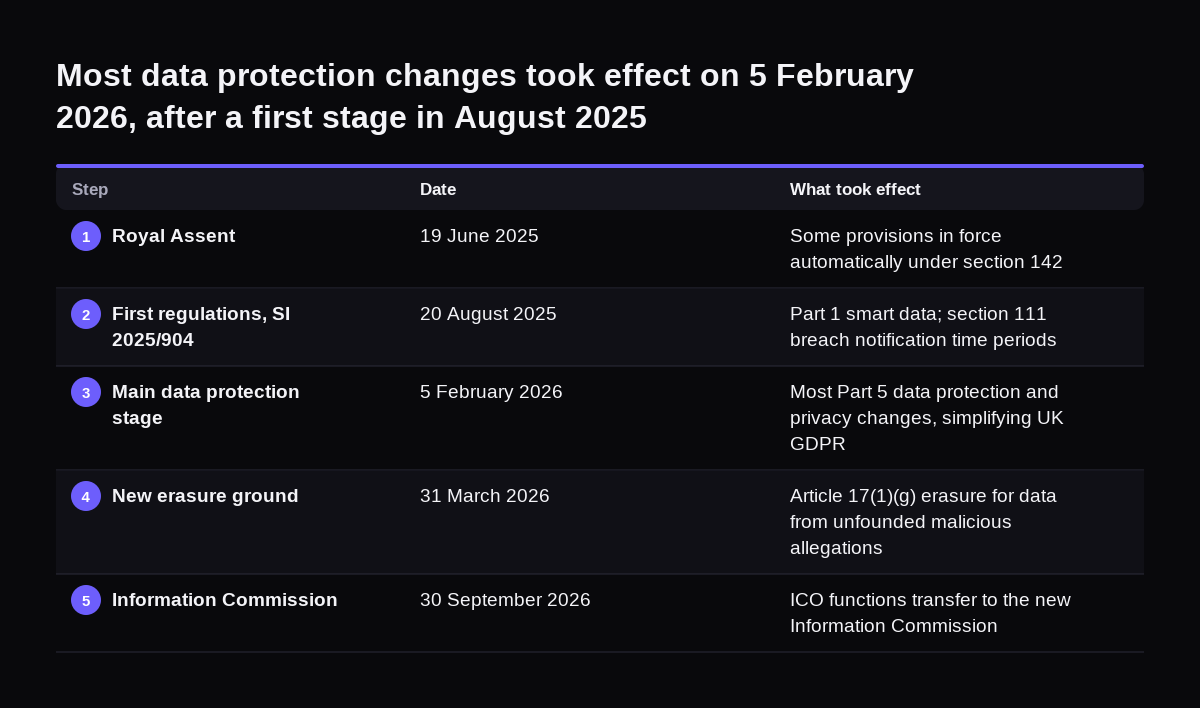
The DUAA came into force in stages, not on one day. The government planned four main stages and published them in its commencement plan on GOV.UK. Some provisions took effect automatically on Royal Assent under section 142 of the Act. Others needed separate regulations.

The dates that matter to a company using AI are these:

  • 19 June 2025: Royal Assent, with some provisions in force automatically.
  • 20 August 2025: the first commencement regulations, SI 2025/904, made on 21 July 2025, brought in Part 1 on smart data and section 111 on breach notification time periods.
  • 1 December 2025: most of Part 2 on digital identity.
  • 5 February 2026: the majority of the data protection and privacy provisions in Part 5.
  • 31 March 2026: a new erasure ground, Article 17(1)(g) of the UK GDPR.
  • About 12 months after Royal Assent: the duty on controllers to handle complaints from data subjects.
  • 30 September 2026: the Information Commissioner's functions move to a new Information Commission.

The practical point is simple. The changes in this guide are live, so your policies should already reflect them. If your privacy notice or AI policy was last reviewed before February 2026, it predates most of Part 5.

Most data protection changes took effect on 5 February 2026, after a first stage in August 2025. Date / What took effect. 1. Royal Assent: 19 June 2025 / Some provisions in force automatically under section 142; 2. First regulations, SI 2025/904: 20

Automated decision-making under the DUAA: what eased and what stayed strict

The DUAA eases the rules on automated decision-making, but only for decisions that do not involve special category data. Automated decision-making is a decision about a person taken by a system, with no meaningful human involvement in the outcome. Section 80 of the Act contains the change.

Special category data is the sensitive kind: health, race or biometric data, among others. The DPO Centre's overview of the Act notes that the eased rules do not reach decisions using it. So an AI step that decides something about a person has two possible regimes. Which one applies depends on the data the step reads.

What this means for an AI workflow

Map every step where an AI tool decides something about a customer, an applicant or an employee. For each step, record three things:

  • whether the step decides an outcome for the person or only prepares work for staff;
  • whether the input can contain special category data;
  • whether a person reviews the outcome before it takes effect.

A step that sorts work for staff is low concern. A step that refuses a claim or rejects a candidate is a decision about a person. Where special category data can appear in that step, plan for the stricter rules and a human in the loop. The ICO has published new and updated guidance on the Act. Check it before you automate any decision that affects a person.

Recognised legitimate interests and direct marketing under the DUAA

Recognised legitimate interests are a DUAA concept that removes the balancing test for specific purposes listed in the Act. The processing must still be necessary, and it cannot support a solely automated significant decision. The balancing test is the part of a Legitimate Interests Assessment that weighs your interest in using personal data against the person's rights. The listed purposes include disclosures to public bodies, national security, emergency response, crime prevention and safeguarding.

Those purposes are public-interest ones. Most everyday AI uses in a business are not on the list. Enriching sales leads in Zoho CRM, summarising customer calls or scoring prospects still rest on your ordinary lawful basis. If you rely on legitimate interests for those, keep doing the assessment and keep it on file.

Direct marketing as a legitimate interest

The DUAA now names direct marketing in the UK GDPR as an example of processing that may be a legitimate interest. It is not a recognised legitimate interest, so you still need the necessity and balancing tests and a written assessment. That clarity helps when an AI tool drafts or segments marketing based on customer data. It does not replace PECR. The PECR rules for email still apply: consent, or the soft opt-in for existing customers, whether the campaign runs from Zoho Campaigns or another tool.

One PECR change sits next to this. Section 114 of the Act deals with electronic mail for direct marketing by charities. Since 5 February 2026 the soft opt-in exemption to consent also covers charities. If you are a charity using AI to personalise appeals, that change is worth a separate review.

The DUAA complaints duty: a data protection complaints process

The DUAA requires organisations to have a data protection complaints process. The ICO lists this among the new requirements on its page about the Act. The duty has applied since 19 June 2026, to complaints received on or after that date. The ICO now states that all provisions affecting data protection law are in force.

A data protection complaint is a complaint from a person about how you handle their personal data. It is separate from a complaint about your product or service. In practice the two arrive through the same channels: email, web forms, phone and chat. Your process has to catch the data protection ones wherever they land.

Why AI makes this duty more pressing

AI tools create new grounds for complaint. A customer may object that a chatbot used their order history, or that an automated step refused them. Those complaints need an owner and a record. Decide three things now:

  • where data protection complaints are logged, for example a dedicated category in your helpdesk;
  • who in the company owns the reply;
  • how a complaint about an AI decision reaches the person who can review that decision.

If you run support in Zoho Desk, a separate department or ticket category gives you that log without a new system. Read the ICO's own guidance on the complaints process before you write yours.

Cookie consent and PECR under the DUAA: low-risk exceptions, higher fines

The DUAA widens the exceptions to cookie consent. Before, only cookies needed to send a communication or strictly necessary for the service were exempt. Now certain low-risk cookies are exempt too, such as basic analytics or website optimisation, according to the DPO Centre's overview.

This matters to AI users because AI tools often arrive on your website. A chat assistant, a recommendation widget or an analytics script may each set cookies. Some of those may now fall into the low-risk exception. Others, such as cookies used for advertising, still need consent.

PECR fines now match the UK GDPR

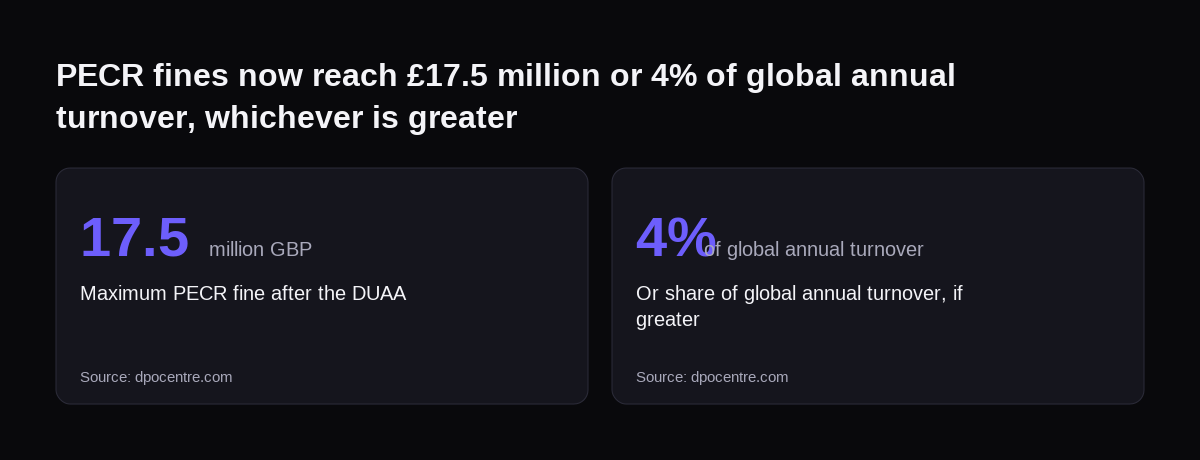
The DUAA raises PECR penalties to the UK GDPR level. The maximum is £17.5 million or 4% of global annual turnover, whichever is greater. Before, a cookie or marketing breach sat under a lower ceiling. The maximum fine for a cookie breach is now the same as for a serious data breach.

Do a cookie audit with the AI tools included. List every script on your site, what it sets and why. Then sort each one: strictly necessary, statistics or appearance, or consent required. For statistics and appearance cookies, explain them clearly and give visitors an easy way to object.

Update your banner and your cookie notice to match. Do not move a cookie into an exempt group because it is convenient. Move it only when its purpose fits the exemption.

PECR fines now reach £17.5 million or 4% of global annual turnover, whichever is greater: Maximum PECR fine after the DUAA 17.5 million GBP, Or share of global annual turnover, if greater 4% of global annual turnover
Source: dpocentre.com

Worked example: Claude triaging Zoho Desk tickets under the DUAA

A worked example shows how the DUAA rules apply to one real workflow. Take a 40-person UK distributor that wants Claude to triage incoming support tickets in Zoho Desk. Claude reads each ticket, classifies it and routes it to a queue. Anthropic positions Claude Haiku 5.5 for high-volume tasks such as classification, extraction and routing, so it suits this job.

The company wants Claude to do four things. Each falls under a different part of the Act:

  1. Route a ticket to the returns queue. This prepares work for staff and decides nothing about the customer. No automated decision concern.
  2. Decline a warranty claim outside the warranty period. This decides an outcome for the customer. With no special category data, the eased rules may apply, but a solely automated decline still needs safeguards: tell the customer, let them make representations, offer human review and let them contest it. A person signing off each decline is the safer design.
  3. Handle a ticket that mentions a medical condition. Health is special category data, so the eased rules do not apply. Claude flags the ticket and a person handles it.
  4. Handle a customer who objects to the triage. The ticket goes to the data protection complaints category, owned by a named person.

At Svennis, we mark each step in a Claude workflow as either "Claude acts" or "a person signs off" before anything goes live. Steps that can touch special category data always go on the person's side. For the Zoho Desk connection itself, we build a connector, an MCP server, a plugin or a skill. We show the options with their cost, and the client chooses.

DUAA action table: what to update in policies and processes

The table below turns the DUAA changes into concrete updates for a company using AI. Each row names the change, the document or process it touches, and the action to take. Work through it with whoever owns data protection in your company.

DUAA changeDocument or process affectedAction for an AI user
Automated decision-making eased, except for special category dataAI policy, process mapsList every AI step that makes a significant decision about a person. Mark special category inputs. Where a decision is solely automated, tell the person, let them make representations, give them human review and let them contest it.
Recognised legitimate interestsRecord of lawful basesCheck whether any AI use fits a listed purpose. Keep assessments for the rest.
Direct marketing named as a possible legitimate interestMarketing lawful basis, privacy noticeKeep a written assessment for AI-assisted marketing. Keep following the PECR rules for email: consent, or the soft opt-in for existing customers.
Data protection complaints processComplaints procedure, helpdesk setupCreate a logged channel and an owner, acknowledge each complaint within 30 days and respond without undue delay. Route complaints about AI decisions to a reviewer.
Low-risk cookie exceptionsCookie banner, cookie noticeAudit scripts from AI tools and reclassify only those that fit the low-risk description.
PECR fines raised to £17.5 million or 4%Risk registerRaise the rating of cookie and marketing risks to match.
Subject access requests: identity proof, proportionate searchRequest procedureStart the one-month clock when you receive the request, or when you receive proof of identity if you had reasonable doubts and asked for it. Document how you search AI logs.
Information Commission replaces the Information CommissionerPrivacy notice, policiesUpdate references to the regulator from 30 September 2026.

Most rows are document updates that take hours, not weeks. The complaints process and the automated decision map need more thought, because they change how staff work.

What the DUAA means for a UK company using AI tools

For a UK company, the DUAA mostly lightens existing rules while adding a few new duties. Beyond the four changes above, three more affect how you run AI tools day to day.

Subject access requests

A subject access request is a person's request for a copy of the personal data you hold on them. Under the DUAA, the one-month deadline starts when you receive the request. If you have reasonable doubts about who is asking and request proof of identity, it starts when you receive that proof. You only have to run a reasonable and proportionate search. AI tools keep conversation histories and logs, so decide in advance which of those your search covers.

International transfers

The DUAA lets the Secretary of State test whether another country's data protection standards are "not materially lower" than the UK's. That matters when your AI vendor processes data abroad. Separately, the European Commission renewed the UK's adequacy decisions on 19 December 2025 until 27 December 2031. That keeps data flowing from the EEA to the UK. It does not cover data you send out of the UK to a vendor. Our page on where your data sits, layer by layer explains how to trace that path for an AI setup.

What the Act does not do

The DUAA is not a UK AI act. Its AI provisions concern copyright. Section 135 required an economic impact assessment of the copyright and AI policy options, and section 136 a report on the use of copyright works in developing AI systems. The EU AI Act can apply to a UK company that places AI systems on the EU market or whose AI output is used in the EU; see our post on EU AI Act duties for small firms.

Next steps for complying with the DUAA when you use AI

The fastest way to comply with the DUAA is to work from your AI tools outwards, one process at a time. Five steps cover most companies:

  1. List your AI uses. Write down every place an AI tool reads or acts on personal data, including website widgets.
  2. Map the decisions. For each use, mark whether it decides something about a person and whether special category data can reach it.
  3. Set up the complaints channel. Create a logged category in your helpdesk and name an owner.
  4. Audit cookies. Reclassify scripts against the low-risk exceptions and update the banner.
  5. Update the documents. Privacy notice, AI policy, lawful basis record and request procedure, using the action table above.

Read the primary sources as you go. The ICO's page on the Act lists the guidance it is still writing, and the GOV.UK commencement plan shows which provisions are live.

If you are planning a new AI process, decide the human sign-off points before you build it, not after. Our guide to AI law in the UK sets out the full legal picture for that planning. When you are ready to build, our AI automation page shows how the work runs and what it costs.

Sources

  1. ICO: Data (Use and Access) Act 2025
  2. GOV.UK: Data Use and Access Act 2025, plans for commencement
  3. legislation.gov.uk: The Data (Use and Access) Act 2025 (Commencement No. 1) Regulations 2025
  4. legislation.gov.uk: Data (Use and Access) Act 2025
  5. legislation.gov.uk: Data (Use and Access) Act 2025, contents
  6. legislation.gov.uk: Data (Use and Access) Act 2025, section 135
  7. The DPO Centre: Early overview of the Data (Use and Access) Act 2025
  8. Anthropic: Models overview
Free, 30 minutes

Pick a time. Bring the process this article made you think of.

You leave with a clear yes or no on putting Claude on it, and the step that fits from our published prices. You speak to someone who builds the agents, not a salesperson.

Prefer to call? +44 7588 772736

30 minutes · video call · free
  1. 1Time
  2. 2Details
  3. 3Booked